
2026 Commencement Welcome
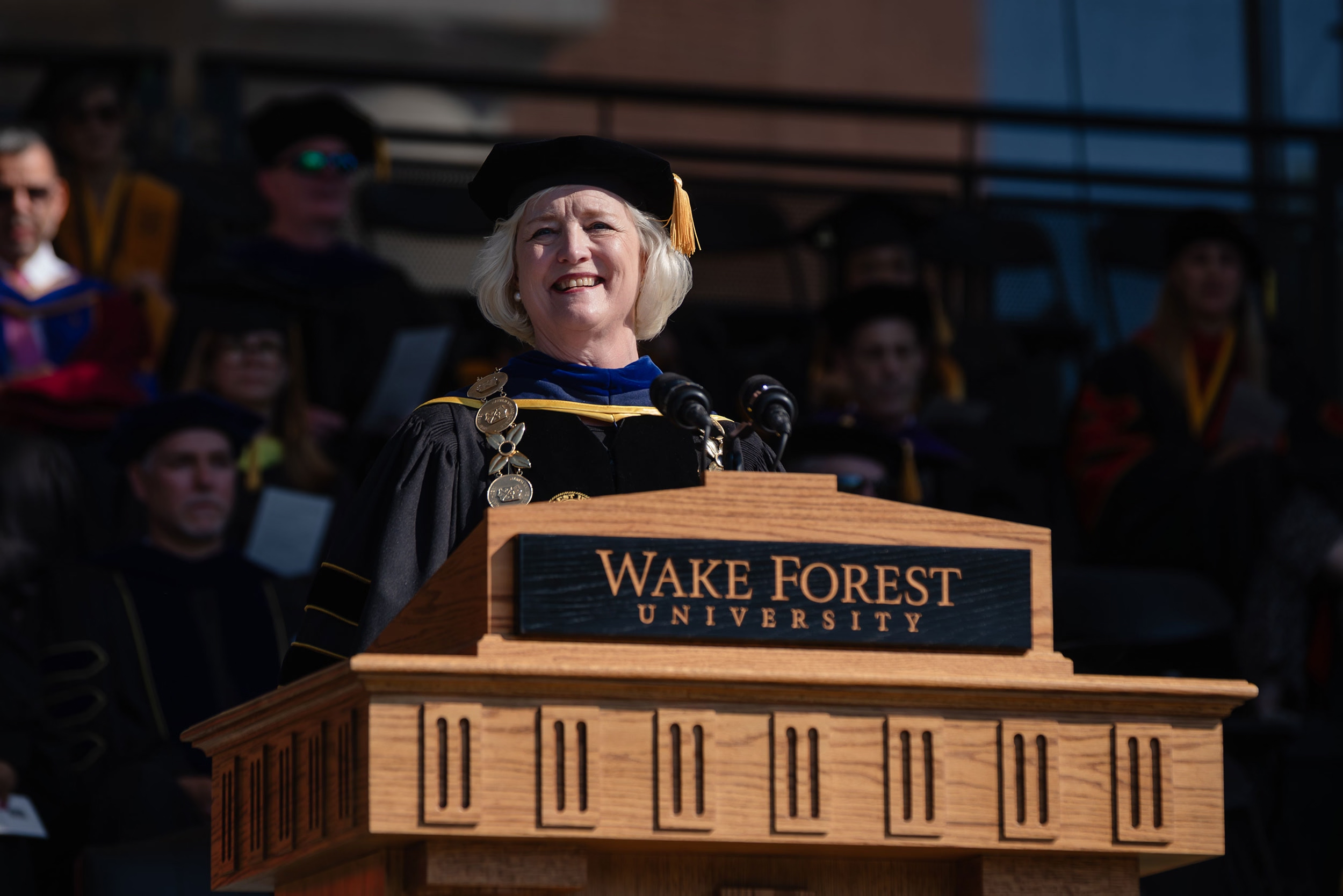
Commencement 2026 Address on May 18th, 2025. Remarks as prepared.
Good morning. As the President of Wake Forest University, it is my honor and distinct privilege to welcome you to our commencement exercises for the Class of 2026.
On behalf of our faculty, staff and trustee colleagues, thank you for joining us to celebrate this most deserving class of graduates.
Class of 2026, are you ready?
Good!
This is a day you have been waiting for and working toward for a long, long time.
A day of celebration, of recognition, and perhaps even just a bit of relief.
So take a deep breath; take in these surroundings; and revel for just a moment in the fact that you are here – you made it!
Commencement on Hearn Plaza is one of Wake Forest’s most cherished and visible traditions.
And as I thought about what I wanted to share with you today, the power of our history and our traditions was very much on my mind.
So in honor of our teacher-scholar model, I decided that today was a perfect time to engage in one last learning opportunity for you all and hopefully one that will last a Demon Deacon lifetime!
Later in this ceremony, you will take part in the singing of our alma mater – something at this point you have probably done many, many times.
But today’s rendition has an extra layer of poignance.
When we sing the alma mater today after the conferral of your degrees, this will be your very first chance to sing it as a Wake Forest alumnus!
And for me, it is likely the last time I will sing it as your 14th President.
And that got me thinking – what is our alma mater really all about?
And why does it matter today?
After all, the lyrics are undeniably old-fashioned – having been written by George W. Paschal, Wake Forest faculty member and alumnus of the College Class of 1892.
And yet, it still resonates so deeply with Wake Foresters across generations.
You will sing it at reunions.
You will sing it at Wake Forest sporting events.
You may even find yourselves signing it with friends at weddings and other special events, years into the future.
So I offer today this one final lesson.
Because there is something important about this alma mater.
Across cultures and communities, alma mater anthems give us a shared language for what is otherwise difficult to put into words.
What it means to belong to a place, and to one another.
And yet… when we first encounter the alma mater, the words can feel unfamiliar, or even silly!
I remember that feeling myself.
When I first arrived at Wake Forest,
lines like ‘our humble lays’ and ‘thy brow with bays entwined’ –
gave me pause, even a chuckle;
And I suspect many of you had a similar reaction when you first stood in Wait Chapel at New Student Convocation four years ago, hearing and singing those words for the first time.
But something magical happens over time with their repetition.
As one lives here, learns here, and forms friendships, the words begin to take on new meanings.
They settle in.
And before long, the words are no longer just lyrics.
They become part of how you understand this place – and your connection to it.
So let’s begin at the beginning.
Dear Old Wake Forest
Thine is a Noble Name
Thine is a Glorious Fame
Constant and True…
At first, this could sound like a simple description of our great university.
But the longer you are here, and the more you hear it,
you begin to understand that it is also a description of us,
the people who are part of Wake Forest.
That “Noble Name” and “Glorious Fame” Paschal writes about may feel abstract, but who we are, our reputation, our story was built by the work, integrity, and contributions of those who have come before us… and it will now include all of what you do too.
As I have shared on Founders Day each year, being part of this University is to be a founder for its future.
You are now part of the Wake Forest story.
A story that is constantly unfolding, constantly true, and each of us has our own true version of it.
We give thee of our praise.
Adorn Thine Ancient Days
Sing Thee Our Humble Lays
Mother So Dear
Here we find words of gratitude – of honoring all that has come before.
And that sentiment, too, gains in connection for each of us over time.
Because none of us arrives here alone.
Rev. Cho reminded us of this in his powerful Baccalaureate address yesterday.
We enter a community. We are shaped by it.
And we contribute to it, in ways large and small.
The last phrase of this first verse, that we all sing so loudly:
“Mother, so dear”
points to something real:
This place has, in its own way, cared for you… nurtured you…
and helped shape who you have become,
indeed as only a mother could.
Moving then to the much lesser known verse 2 – [joke] big bonus points to those of you with this part committed to memory!!
Dear Old Wake Forest
Mystic Thy Name to Cheer
Be Thou our Guardian Dear
Fore’er and Aye.
Here I’m drawn to the use of the word mystic, admittedly, not a word or a concept we always connect to in academia!
Perhaps what it captures is this:
That what you take with you from Wake Forest cannot be reduced to a list of courses, or experiences.
It is something deeper; something that stays with you and in you;
and guides you.
You will leave this place – but “Mother, so dear” will never leave you.
And finally:
We Bow Before Thy Shrine
Thy Brow with Bays Entwine
All Honor Now Be Thine
Mother, Today.
Indeed, these are also not words we use every day – unless perhaps you’re in the Marching Band! Or the Choir!
A ‘shrine’ invokes a sacred place to pause, intentionally, and recognize what matters;
And the notion of “bays” or laurel leaves crowning one’s head,
has long been a symbol of honor, achievement, or a job well done.
This stanza offers a moment not unlike this commencement.
A moment to pause;
To recognize what you have accomplished;
To honor the work and the relationships that brought you to today –
and to do so together, before moving forward into the future.
Over the past years, we have sung these words together –
from your first year here until today;
and they have come to mean something more to me as well.
They have, in a way, been written on my heart.
And that is part of why today feels especially meaningful, because like you, I’m making a change too as this is my last commencement as Wake Forest’s president.
In this sense, I feel a particular kinship with you, Class of 2026.
We are, in our own ways, stepping forward together;
carrying with us what we have experienced here,
and looking ahead to what comes next.
And if there is one thing I hope you take with you, it is this:
The most enduring part of your time at Wake Forest will not be
this beautiful campus, or your classes,
or even the traditions you have cherished.
It will be the relationships you have formed here.
The friendships
The mentors
The people who have challenged and supported you most.
These connections become foundational for the rest of your life.
And these relationships will shape your lives in ways you may not yet fully see, sustaining you as you step into what’s next.
So take care of them; Strengthen them; and continue to grow them.
And as you take these next steps, remember: you are not simply leaving Wake Forest with a degree.
You are leaving with the capacity…
and the responsibility… to make a difference.
To be catalysts for good.
To confront injustice when you encounter it.
To embrace the full breadth of our shared humanity.
To use what you have learned not only to advance your own success, but in service to others, as a commitment to Pro Humanitate.
So do not be content to stand on the sidelines.
You have the power to make a meaningful difference!
Oh….yes….there will be moments when others doubt you;
when your ideas will be questioned;
when others will not easily share their trust with you.
In those moments, let your confidence shine from within – and from what has been formed here.
Embrace what it means to carry Wake Forest forward –
To live in a way that reflects the things we sing about.
To be constant and true.
To honor what has shaped you.
And to move forward with purpose, with and for others.
So, when you find yourself singing “Dear Old Wake Forest” – whether here on this campus, or far, far from it;
It will not be “just” a song anymore.
The words will be a tie that binds you to this community.
And a powerful reminder,
Of who you were when you arrived here.
Of who you became.
And of the people who walked beside you on your Wake Forest journey.
All honor now be thine.
Mother, today.
Congratulations, Class of 2026.
Categories: Speeches